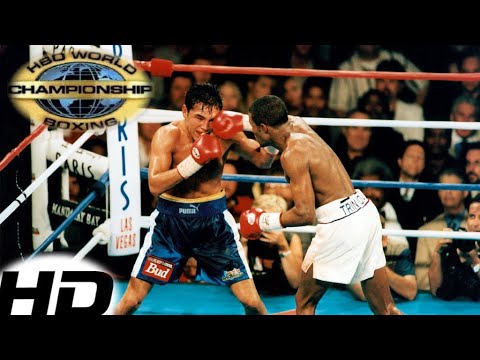
Oscar De La Hoya surrendered the closing rounds and paid the price against Felix Trinidad on September 18, 1999, losing a majority decision in their welterweight unification fight at the Mandalay Bay Events Center in Las Vegas.
“The Fight of the Millennium” matched two 26-year-old champions at their commercial peaks. De La Hoya (31-0, 25 KOs) held the WBC title and occupied the No. 1 position in The Ring’s pound-for-pound rankings. Trinidad (35-0, 30 KOs) had made 14 successful defenses of the IBF belt and brought frightening power from Puerto Rico.
The anticipated slugfest never developed. De La Hoya controlled much of the first nine rounds with his jab, movement, and quick combinations. He repeatedly beat Trinidad to the punch, bloodied his nose and damaged his left eye. Tito pursued him but struggled to get close enough to land sustained offense.
After nine rounds, De La Hoya led 87-84 on Jerry Roth’s card and 86-85 on Bob Logist’s. Glen Hamada had it 86-86. Oscar was winning, but the margins were much thinner than his corner believed. That miscalculation changed the fight.
Robert Alcazar and adviser Gil Clancy treated the lead as money already deposited in the bank. De La Hoya followed their instructions by circling, retreating, and minimizing exchanges during the final three rounds. Instead of making Trinidad pay for following him, Oscar stopped throwing enough punches to control the action.
The strategy created terrible scoring optics. Trinidad was not landing clean combinations, but he was marching forward while De La Hoya looked intent on escaping each exchange. Judges are supposed to reward effective aggression, not movement by itself. Oscar made Trinidad’s pressure look more effective by refusing to answer it.
Trinidad outlanded him 64-33 over rounds 10 through 12. Those closing sessions gave Roth and Logist an easy reason to reward Tito. De La Hoya also failed to separate himself clearly enough in tight earlier rounds, particularly the fourth and ninth. Winning either session decisively would have protected him from his late retreat.
Roth scored the fight 115-113 for Trinidad, Logist had it 115-114 for Trinidad, and Hamada returned a 114-114 draw. Tito unified the WBC and IBF titles and handed De La Hoya his first professional defeat.
The overall punch totals strengthened Oscar’s complaint. He landed 263 of 648 punches, compared with Trinidad’s 166 of 462. De La Hoya held a huge advantage with the jab, while Trinidad led only 124-120 in power punches. Oscar landed nearly 100 more punches but lost because boxing is judged by rounds rather than totals.
Calling the result a robbery ignores the opening De La Hoya gave the judges. He boxed better for most of the night and likely deserved the decision, but he willingly abandoned the final quarter of the fight. His corner offered false security, and Oscar accepted it without demanding proof.
A rematch promised enormous money but collapsed over purse splits, weight, and promotional control. Trinidad wanted the larger share as the official winner and preferred 154 pounds. De La Hoya wanted a chance to correct the loss on his own terms.
They never fought again. De La Hoya’s retreat turned the last major superfight of the 20th century into boxing’s clearest warning against trusting an invisible lead.