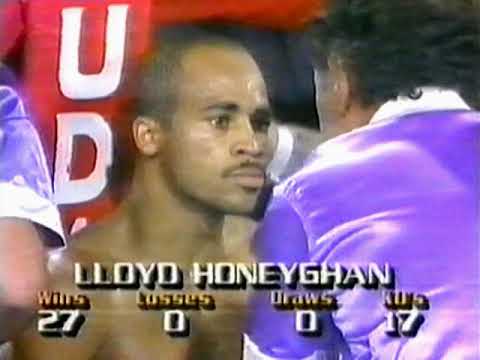
Donald Curry had bigger fights in view when Lloyd Honeyghan arrived in Atlantic City on September 27, 1986. A move up in weight and a possible meeting with Marvin Hagler were part of the champion’s future. Honeyghan made sure neither could be discussed as though the undisputed welterweight title were already safely defended.
Curry was unbeaten in 25 fights and regarded as one of boxing’s finest fighters. Honeyghan, the British, Commonwealth and European champion, was unbeaten too, but entered The Brawl on the Boardwalk as a heavy underdog. Curry had called him a “ragamuffin.” It was easy for the favorite’s camp to picture what came after this fight. That did not mean Curry had prepared to lose it.
Honeyghan’s answer was pressure from the opening bell. Curry was dangerous when he could set his feet, read an opponent’s attack and counter with clean punches. Honeyghan crowded him, worked at close range, and kept advancing after Curry landed. The champion had to spend too much time holding or punching while retreating to establish his usual rhythm.
The challenger’s right hand did the most visible damage. It shook Curry in the second round and forced him to clinch. Curry boxed his way back into the third and fourth, showing that his skill had not disappeared. Yet he could not make Honeyghan cautious. Two more rights hurt him in the fifth, and Curry again grabbed to get through the round. The pressure was sustained; the biggest punches came after Honeyghan had made the champion work for every bit of space.
Curry’s difficult weight cut and unsettled camp were real parts of the story. They cannot stand in for the six rounds Honeyghan fought. The challenger did more than catch a weakened champion on a bad night: he took away Curry’s preferred distance, recovered when Curry rallied, and led on all three scorecards.
A cut near Curry’s left eye, apparently caused by a clash of heads, opened in the sixth. After the round, Curry indicated he was finished, and a ringside physician advised that he should not continue. It is impossible to know how much of that decision came from the wound and how much from the punishment already absorbed. The cut ended the contest; Honeyghan had been winning it.
Honeyghan left with the WBA, WBC, IBF and Ring titles. Curry later became a champion at junior middleweight, but the image of an untouchable welterweight was gone. Atlantic City became Honeyghan’s defining triumph because he crossed the ocean, faced the man many expected to beat him, and made the champion fight on his terms.